Before printed money became the common means of payment, nations around the world used gold to make transactions. For example, the United States with the gold dollar, Germany with the gold mark, and Britain with their gold sovereign. Now that paper money serves as the standard, old currency becomes a rare commodity that primarily acts as a collectable investment.From simple purchases like groceries and earnings to trading, the British used gold sovereigns in their routine up until 1914. As a result, people now regard it highly as a coin with value beyond its gold content. How is it so? This article will explain everything you need to know about it. This article will delve into its history, characteristics, and current value.
History of the gold sovereigns
King Henry VII introduced the first gold sovereign in 1489 as England’s most valuable coin. It featured his own enthroned portrait and the royal arms that commemorate the stability after the Wars of the Roses. James I ordered the production to halt in 1604, reduced its weight, and renamed the coin ‘Unite’. Furthermore, the modern version did not exist until 1817, during George III’s Great Recoinage. The classic gold sovereign that featured St. George slaying the dragon debuted and standardised the 22-carat crown. Workers and shops used billions of these coins across the British Empire until World War I. World War I then prompted panic buying that led to hoarding in 1914. Authorities withdrew over £100 million of gold sovereigns, issued paper £1 notes, and melted the rest. These efforts resulted in the end of the coins’ circulation by 1917, when currency shifted to paper money. Ultimately, these efforts transformed commonplace currency into high-value collectables and bullion.
The characteristics of the gold sovereign
Every gold coin has its unique characteristics, including size, content, and designs. This helps distinguish the value of each coin that brings its exclusive identity. The gold sovereign stands out among others more than its gold content, primarily due to its historical continuity. Consistently minted since 1817, the precious coin provides balance for both history and investment. Knowing the characteristics of a rare sovereign coin could help to identify its authenticity amid rising counterfeits and avoid a fake one. Without this knowledge, investors or collectors risk overpaying premiums or accepting underweight coins. To get to know it better, here are the characteristics:
Physical characteristics
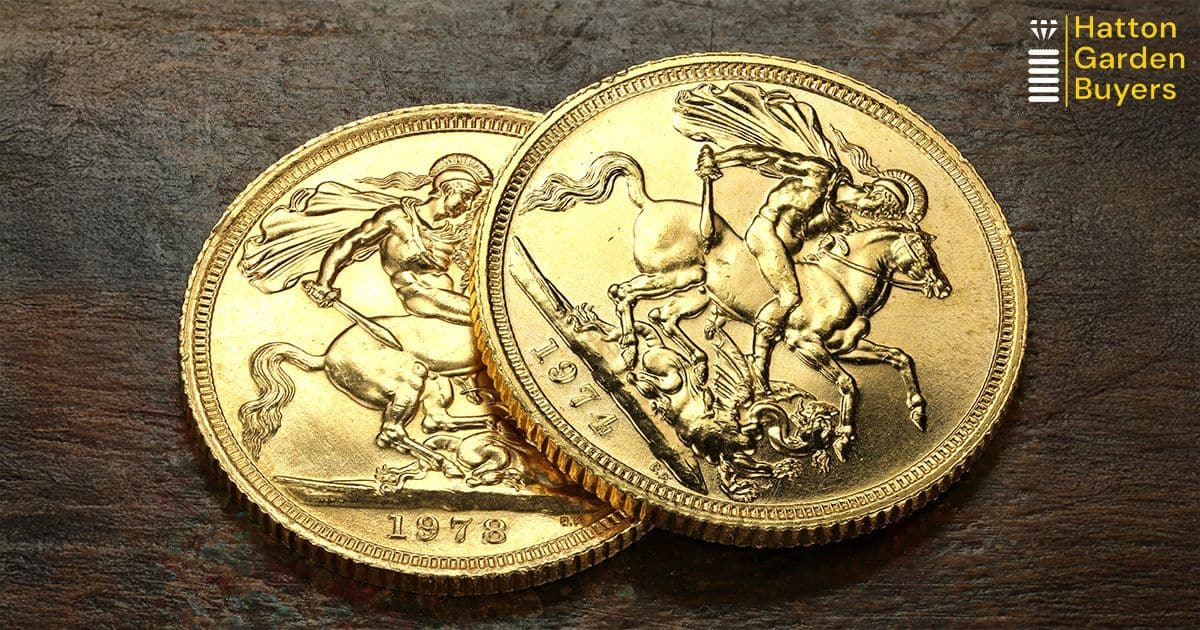
The standard full version of the gold sovereign uses 22-carat crown gold equal to 91.67% gold. The coin weighs 7.98 grams (0.235 troy ounces of gold) and contains 8.33% copper to improve durability. This alloy protected it from purity loss, which also resulted in the reddish hue of the coin. Other physical traits of it are that it has a diameter of 22.05 mm, combined with a thickness of 1.52 mm. The edge or rim features 150-180 uniformly spaced fine vertical reeds to prevent coin clipping and forgery.
Design characteristics
There are two designs for each side of the gold sovereign, the obverse (head side) and the reverse (tails side). The reverse side commonly depicts Benedetto Pistrucci’s St. George slaying the dragon, reinforcing tradition and recognisability. As the obverse features the uncrowned reigning monarch’s portrait, surrounded by various Latin inscriptions that include:
D·G·: Stands for “Dei Gratia”, which means “By the Grace of God”.
Latinised form of the monarch’s name. e.g., “GEORGIVS V” for George V.
“Rex” (King) or “Regina” (Queen).
F·D·: “Fidei Defensor”, meaning (Defender of the Faith)
“Britanniarum” (of the Britains) or “Britt Omn” (Britain All)
A·D· [year]: “Anno Domini”, meaning (In the Year of Our Lord), followed by the mint year.
Legal/tax status in the UK
The Coinage Act of 1971 and the Royal Proclamation of 1763 classify the gold sovereign as a UK legal tender. Because of this, even with a face value of £1, the coin has far higher intrinsic gold worth and is protected from counterfeit laws. It is also classified as investment gold under VAT Notice 701/21A, making its purchase and sale exempt from 20% VAT.
Types of gold sovereigns
As a precious metal with high value, the gold sovereign has quite a range of types. MCollectors distinguish most types by their finish (production quality and purpose) and their size. Different sizes stem from historical circulation needs, while the different types of finishes were catered for investment flexibility and collector appeal. Based on finish or production quality, gold sovereigns offer several types, each designed for a specific purpose. Without this, the coins would reduce their investment accessibility, collector demand, and production efficiency, limiting their global dominance as the “chief coin of the world”.
Finish types
There are three common finish types of the gold sovereign. They are bullion, proof, and piedfort. Different types of finishes serve a variety of purposes, mostly to balance production efficiency, investor needs, and collector demand after 1917. Each is unique from the other. To understand it better, here are their details:
Bullion: With its matte/satin finish, it is mass-produced to prioritise pure investment value over collectibility. It is easier to liquidate and tolerates minor imperfections, making it suitable for investors.
Proof: These types of coins were purposely made with premium collector-grade materials, crafted carefully using hand-polished dies to produce sharpness and mirror-like fields.
Piedfort: Known for its double thickness, this type of gold sovereign is an elite proof coin with dramatic effects, catering to collectors seeking rarity/prestige.
Size types
To meet everyday circulation and precise payments, the Royal Mint denominated the gold sovereign in 1817. The British used to pay, for example, half for wages or full for trade. Smaller transactions, as such, made the gold coin required to be split more accurately. Five main sizes of them are:
Quarter: Face valued at £0.25. Smallest, bullion/proof; ideal entry-level.
Half: Worth £0.50 at face value. Popular fractional; ceased circulation in 1926, revived bullion.
Full: The face value is £1. It is the flagship and most liquid.
A gold sovereign contains 7.322 grams of pure gold, making it worth roughly £590. At a spot price of £2,500 per ounce in late 2025, its melt value makes it £590. Buyers pay an extra 3–7% dealer markup for production and handling, resulting in £610–£630 for typical bullion versions; bulk purchases trim this cost further, aided by no VAT.In addition to that, dealers offer sellers roughly £740–£760, minus minor testing charges. A vintage or uncommon sovereign earns up to 20% more from collectors due to unique years or mint symbols. Spot prices vary every day, so consult current quotes from reliable vendors to secure optimal buy or sell rates.
Advantages as an investment
The compact size and tax perks of the gold sovereign favoured it as an appealing investment opportunity. Starting at around £600, investors could already bag one without VAT or capital gains tax in the UK. Portability also plays a part, as it makes storage and shipping simple compared to bulky bars. Investors around the world easily recognised its exclusive worth, so it is quick to sell during market dips or personal needs.Investing in gold sovereigns serves stability, as it is a strong hedge towards inflation. Thanks to its standardised 22-carat purity, the value is solid even when stocks falter or currencies weaken. Durability from the copper alloy ensures coins withstand handling and time, preserving their worth even after years of holding.
Which year is the gold sovereign the most valuable?
The 1920 Sydney Mint Gold Sovereign is the most valuable coin ever sold. In 2021, one of the examples was auctioned for over £650,000. Only seven pieces are known to exist; this coin is priced high due to its extreme rarity. Most of them were melted down during wartime, leaving only a tiny number out of the 360,000 that were made. Moreover, buyers are especially drawn to its “S” mint mark, which shows it was made in Sydney, and to its top SP-66 proof-like grade. It is the only known sovereign from this year that was actually used in circulation, and it survived despite gold recalls and global conflicts.During the 1920s and 1930s, a gold sovereign was mass-smelted, and the Sydney Mint later closed, which reduced supply even further. At the same time, more collectors began searching for coins from the British Empire era. Because of this, the 1920s version now sits above even famous historic coins, including Henry VII’s first coin and Queen Victoria’s rare issues. Today, it marks the ultimate prize for investors, combining gold content, rarity, and historical appeal.
Tips to verify the authenticity
Identifying a genuine gold sovereign can be simple if you know what to look for. Although it is advised to get professional help for verification, a basic check could also be done as a precaution. Using tools like a loupe, a scale, and a magnet can already reveal significant signs of authenticity or forgery.When done correctly, these methods help collectors and investors be more assured in doing transactions, whether buying a second-hand or an inherited gold piece. As a result, a fake gold sovereign could be easily detected with a subtle test of its weight, details, and sound. Inspect your coin with these steps to reduce the risk of counterfeiting.
Visual inspection
With a 10x loupe, look at the scales of the dragon’s tail, the fold in St. George’s cape, and the lettering. Make sure that all the gold sovereign details are clean and sharp. The fake one might look a bit fuzzy and even show tiny bubbles. Do not forget to check the reeded edge; it should have around 150-180 uniformly even grooves. Irregular or shallow grooves often indicate tampering.
Magnet test
A sovereign is not magnetic. It’s almost certainly fake if the coin sticks to a strong magnet like neodymium. Note that there are also other non-gold metals that are also non-magnetic, so you should not rely only on this. Combined with other tests to get a more accurate result.
Sound test
You can do this by tapping the coin gently on a hard surface or by clashing it with another coin. A real gold sovereign produces a bright and high-pitched ring that lasts about 3-5 seconds. Counterfeits tend to make a dull, short sound because the metal density is different.
Sell your gold sovereign conveniently with Hatton Garden Buyers!
The sovereign coin dates back to 1489; it was revived in 1817 with the fixed 22-carat specs for daily currency until WWI hoarding ended the circulation. Today, it has become a rare piece that investors and collectors also chase for its high value. Its portability and liquidity make it worth around ~£610–£760, making the authenticity important. Do you have a gold sovereign you would like to sell? Turn the precious gold coin into cash with Hatton Garden Buyers. We offer cash payouts that are on average 37% higher than industry standards. Transparent, fair, quick, and secure, our service guarantees your satisfaction. Visit our homepage for more information!