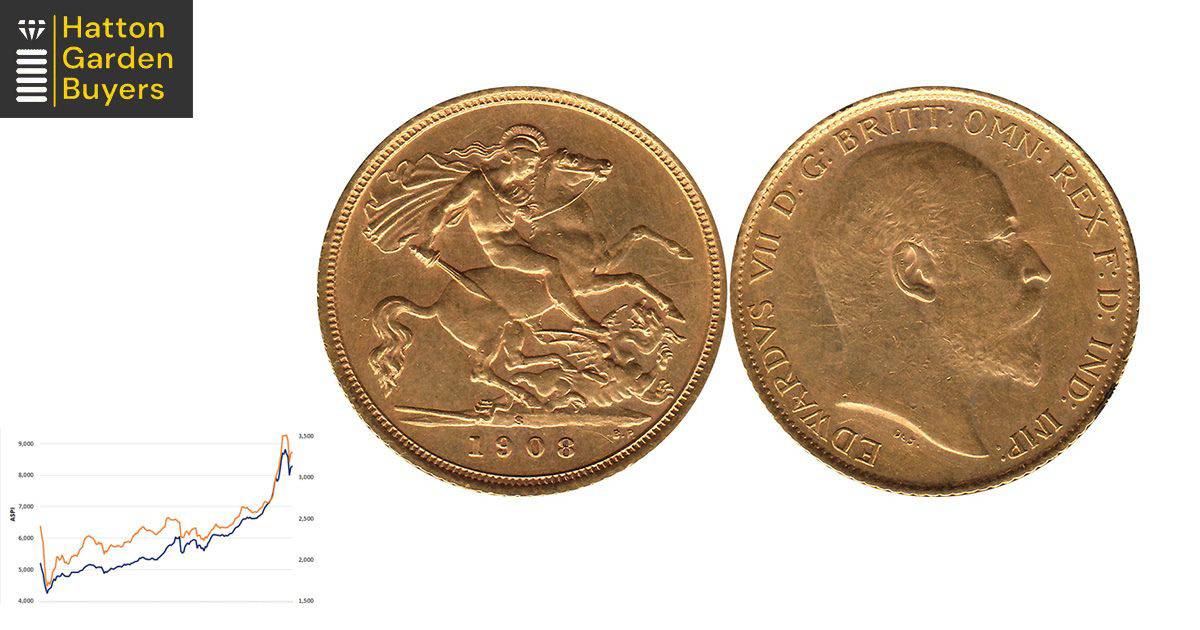
Half Sovereign Value by Year: History and Pricing Factors
ahsan farook
A half gold sovereign may look like a small coin with its value of 50p. However, the real worth lies much higher. Besides the 3.66 grams of 22-carat gold content, it also contains heritage and scarcity. That’s why collectors and investors are keeping track of the half sovereign value when they buy orsell gold. Before one sells or collects, it is a must to know the true value of a half sovereign. Hence, they may get the best deal instead of low offers. In this article, we break down the factors that shape price. You will see how the year makes a difference and which dates earn greater collector attention.
Brief history of half sovereign
The half sovereign first appeared in 1544 under Henry VIII. Tudor mints created it as a 10-shilling coin at first, then the next rulers kept production going. Even though the minting was ended in 1604, more than two centuries later, it was revived by George III. This deep timeline matters for half sovereign value because older issues carry scarcity and premium interest.From 1817 onwards, designs changed often. George IV and Victoria issued many pieces through the 1800s. Mints expanded overseas, and demand spread across the empire. Edward VII and George V coins saw heavy use before the First World War halted circulation. The coin returned in 1980 for collectors and in 1982 for bullion buyers. That revival pushed the half sovereign into the modern market as a valued collectable.
What are the half sovereign value factors?
Half sovereign value depends on gold content, condition or grade, rarity, mintage numbers, historic appeal, and investor demand. As it carries 3.66 grams of pure 22-carat gold, the coin naturally follows the live spot price. The coin melt value rises along with the spot. Dealers add small premiums for bullion and higher ones for scarce years. A weak pound can push prices higher within the UK market.Other factors are that limited mint batches become desirable over time, attracting those who chase rarity. Due to low numbers, special releases, such as final rose designs or proof coins, sell well above the spot. Condition matters as well. A mint state coin carries more appeal than one with marks or wear. Graded rare issues can reach prices far beyond the bullion level.Lastly, the market decides the half sovereign value. When more people collect or invest, the price moves up quickly. Economic stress also boosts gold prices, which supports collectable coins.UK tax rulesadd appeal because there is no VAT or capital gains tax. All of these factors together shape the value and explain why some pieces tend to give strong premiums.
Half sovereign value by year
Half sovereign value changes from year to year. While common coins fall close to the gold melt price, a few others can sell for more. Dates with heavy circulation sit near spot levels. Rare proof issues and low mintage examples attract strong collector demand. This is why year matters just as much as condition and metal weight.Historic moments also raise value. Coronation years, the first strikes of a new monarch or the last of a long reign often gain more interest. Some modern releases also collect premiums when they mark design changes or low output. These patterns help buyers judge half sovereigns with better confidence and avoid overpaying.
Victorian and Colonial Era (1817–1901)
Victorian half sovereigns often appear in trade due to long production runs. This keeps average pieces close to the spot, around £380–£500. Rare dates prove exceptions. Proof-only years like 1834 and 1841 often command £2,000–£5,000 due to their rarity. Australian and South African branch mint coins get extra bids thanks to lower output and mint mark interest. Premiums often rise by half sovereign value when demand for early gold grows.
George V Scarce Dates (1911–1926)
First-year 1911 coins hold solid popularity. Collector demand has pushed values higher. Many well-preserved 1911 pieces now fetch £348–£670 depending on condition. Late George V issues like 1925 and 1926 stand out as scarcer coins. Clean high-grade pieces from those years draw £800–£1,500 in strong condition. Buyers favour MS-grade examples since few survive in a perfect state. These dates show where rarity matters most.
Modern Demand (1982–2025)
Later issues remain popular with investors who value both gold content and collectable appeal. To provide you more detail, read this below:
The 1982 restart year often fetches £450–£600 for good-condition proof or standard-grade examples, higher than ordinary modern coins.
The millennial 2000 edition holds a moderate premium, with typical prices around £380–£450 for regular gold issues and £600–£800 for proofs.
The 2025 final rose attracts extra attention; standard-grade pieces sell near spot around £282–£284, while limited-edition versions can push £500+.
These patterns prove that date and story still shape half sovereign value.
Make your half sovereign sale simple and rewarding!
Half sovereigns hold strong value thanks to their gold content, historic appeal, and steady demand. Whether you own bullion-grade coins or sought-after collectables, the right timing and buyer can make a real difference. With half sovereign value staying competitive and interest remaining high, many sellers find this the ideal moment to assess their coins and consider a sale.When you’re ready to move forward,Hatton Garden Buyers is here to help. Our valuers are equipped with state-of-the-art technology and deep industry insight, ensuring every coin is assessed with precision and transparency. We’re always on hand to answer your questions, guide you through each step, and make sure you feel completely confident and comfortable with the process. Get in touch today and discover how smooth selling your half sovereign can be. Visit our homepage now!